Overview
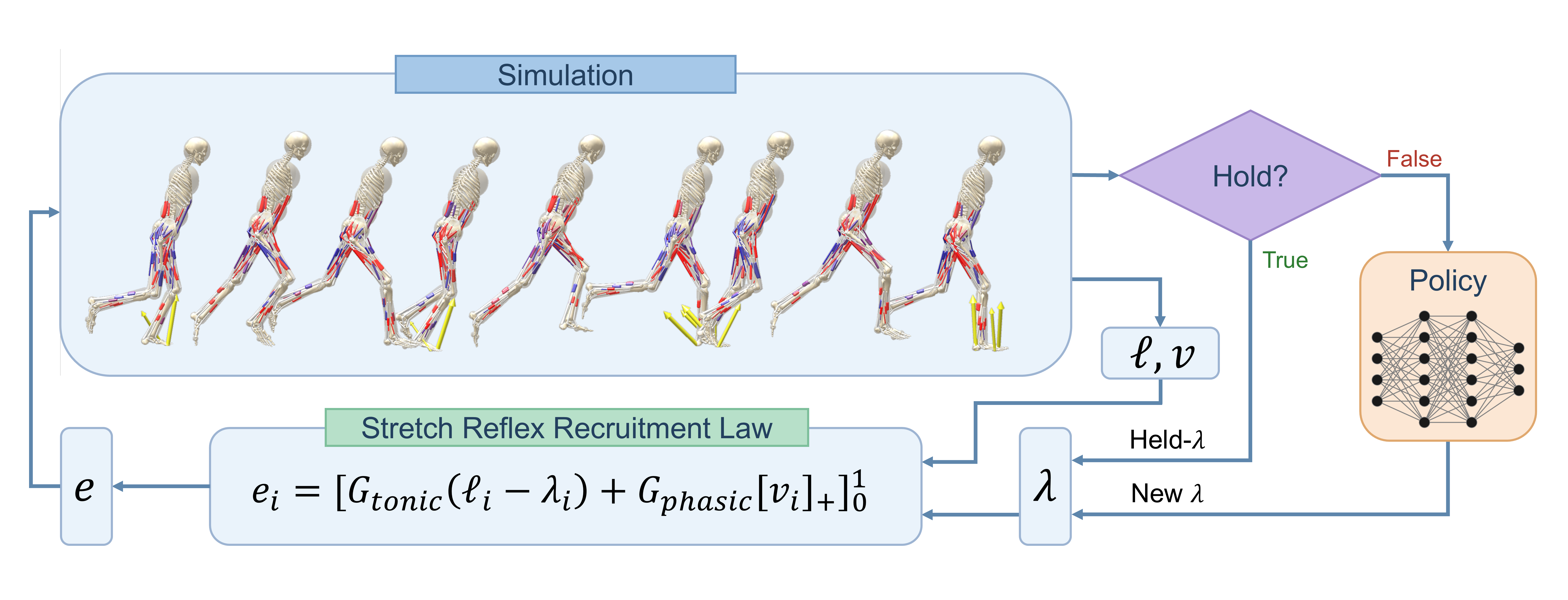
The massive overactuation in the human musculoskeletal system makes it challenging to train musculoskeletal models to generate human-like motion via reinforcement learning, primarily because exploration in the resulting high-dimensional and redundant action space is extremely inefficient. To address this problem, we propose the $\lambda$-hold controller, inspired by the equilibrium-point (EP) hypothesis, which has been widely supported by extensive evidence from human motor control studies. The policy's control variable is the per-muscle EP threshold length $\lambda$, from which a stretch-reflex recruitment law computes the muscle excitations automatically. Holding each $\lambda$ over an interval of the gait phase also sharply reduces the frequency at which the policy must be queried. Consequently, the controller, to our knowledge for the first time, enables a muscle-actuated skeletal model to learn human-like sprinting using only a minimal reward within an hour of training. The efficient exploration through the proposed $\lambda$-hold controller is not merely an engineering trick but an approach grounded in physiology, bringing together the EP hypothesis, intermittent control, and optimal feedback control. Beyond encapsulating human-like behavior in predictive simulation, this achievement contributes to developing a learnable model of the human motor controller.
Both controllers were trained for the same 150M simulation steps. Our λ-hold controller, however, reaches that same number of simulation steps in far less wall-clock time than DEP-RL.
@misc{lee2026lambdahold,
  title         = {{Lambda-Hold Control: Human-Like Movement Emerges from a Minimal Task Reward in Predictive Musculoskeletal Simulation}},
  author        = {Jun Hyuk Lee and Chihyeong Lee and Jooeun Ahn},
  year          = {2026},
  eprint        = {2608.17030},
  archivePrefix = {arXiv},
  primaryClass  = {cs.RO}
}