How can we solve the data imbalance problem in training datasets?
Published:
How can we solve the data imbalance problem in training datasets?
Intern · Recognition Team, Vision AI Lab · NCSOFT

NCSOFT is one of South Korea's top three game companies. Within its Vision AI Lab, I worked on the Recognition Team, where I was responsible for developing expression-controllable data generation technology for training facial-expression (emotion) recognition models.
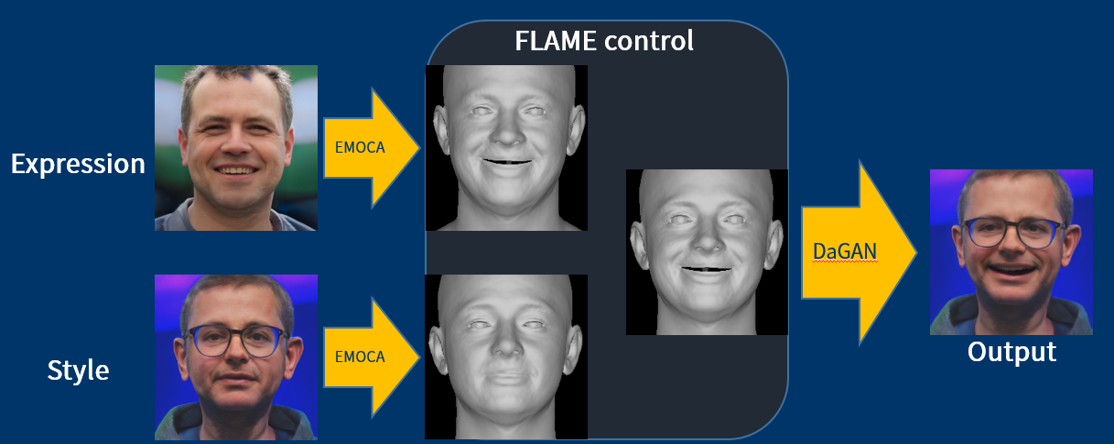
Training an AI to recognize human facial emotions requires a large amount of images of human facial expressions. In practice, however, most of the face images available in the wild are either smiling or neutral, which leads to a data imbalance problem. To address this, I developed a tool that generates large amounts of realistic human face images with any desired expression.
Generating faces with a desired expression
The tool takes two inputs: one image that supplies the target expression and another that supplies the identity (style). Each image is reconstructed into a 3D FLAME face by EMOCA, the desired expression is composed onto the target identity in FLAME's control space, and DaGAN then renders the combined 3D face back into a realistic output image.